
Insights from Robin Taylor, Founder & CEO, Zetta Connect
Artificial intelligence is everywhere now. From property events to industry headlines, terms like AI, machine learning and smart buildings are being used more than ever, but for many building owners and managers, the same question keeps coming up:
What do these terms actually mean, and what do they mean for my building?
It’s a conversation we are hearing more often from clients and partners, so we asked our Founder and CEO, Robin Taylor, to share his view on how these technologies are shaping commercial buildings, and where they can deliver real value in practice.
A smart building starts with data
Modern buildings generate huge amounts of information every day.
Sensors can monitor everything from:
- room temperature
- occupancy levels
- air quality
- lighting usage
- energy consumption
- lift movements
- access control activity
For example, a meeting room might continuously report it is maintained at 21°C, while occupancy data shows no one has entered it all day.
The building has the information, but data alone does not make it smart. A building only becomes truly smart when that information is analysed and used to improve how it performs.
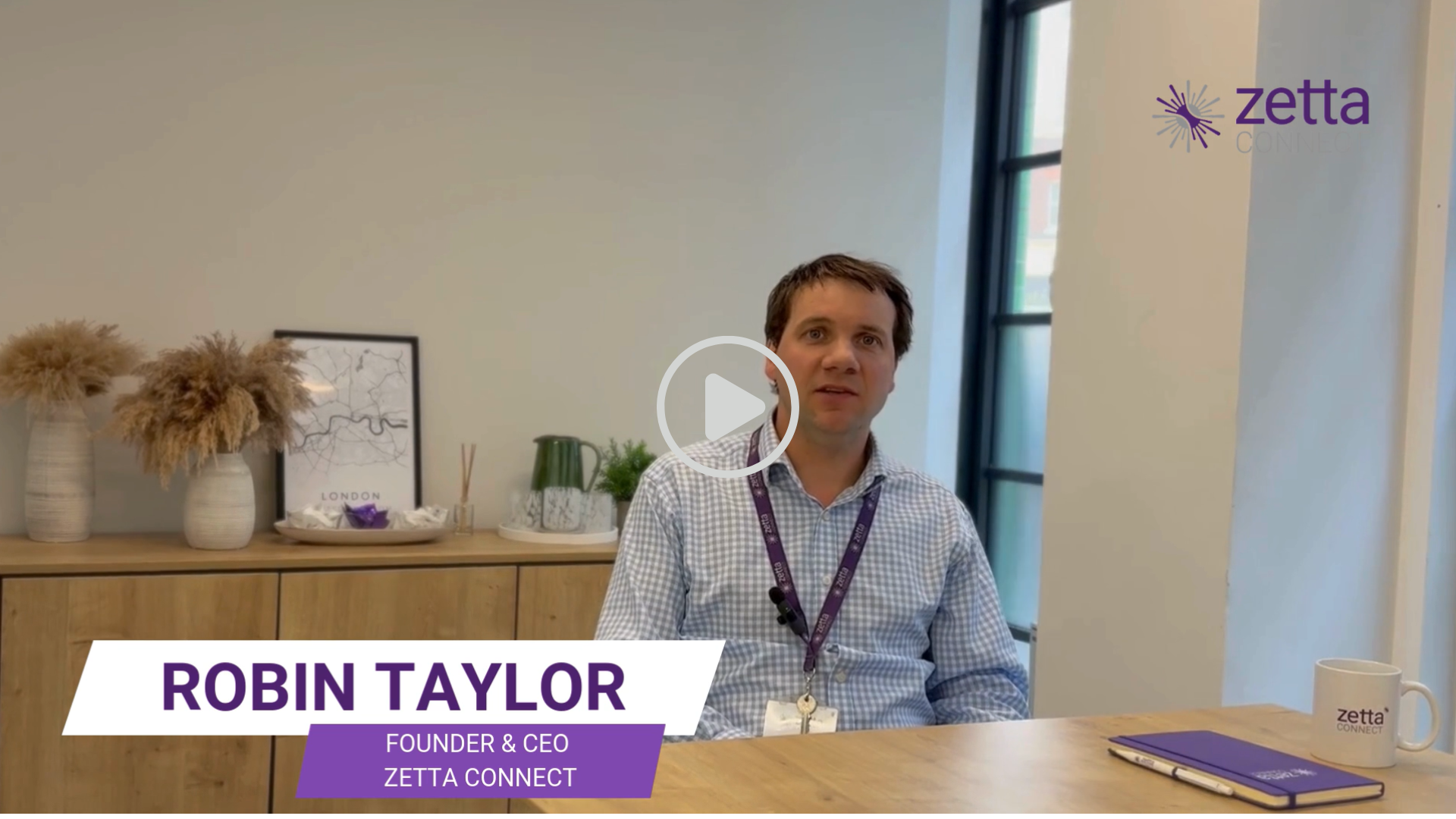
In this short video below, Robin shares his perspective on how AI, data and connectivity are redefining what makes a building truly smart. Click to Watch.
What is machine learning?
Machine learning is a subset of artificial intelligence. Rather than being programmed with fixed rules, it learns patterns in data over time.
At Zetta Connect, we already use machine learning within our network monitoring platform.
For example, our systems track traffic across network links and learn what “normal” looks like based on:
- time of day
- day of week
- tenant usage patterns
If traffic suddenly drops on a typically busy weekday morning, the system flags it automatically.
That could indicate:
- a hardware issue
- a tenant outage
- a wider connectivity fault
This allows our network team to investigate before users are even aware of a problem.
In a building environment, the same approach can help identify:
- unusual energy spikes
- airflow issues
- underused spaces
- early signs of equipment failure
before they become larger problems.
Where smart buildings become smarter
Machine learning becomes most powerful when systems start working together. Take a simple example. A tenant books a meeting room for 3pm. In a traditional building:
- the room may be heated all day
- lights remain on
- ventilation runs continuously
In a smarter building:
- the booking system connects to HVAC
- heating starts shortly before the meeting
- lighting activates on occupancy
- ventilation adjusts based on usage
If the meeting is cancelled, energy is not wasted maintaining an empty room. That is where building data starts becoming genuinely valuable.
What is deep learning?
Deep learning is a more advanced form of machine learning, capable of analysing larger and more complex data sets to make better predictions.
It can help a building understand things like:
- when occupancy typically increases
- how sunlight affects temperature throughout the day
- when heating demand will drop
- when maintenance may be required
For example, if a building learns that strong afternoon sun consistently warms one side of the property, it can reduce heating in those areas or adjust blinds automatically to prevent overheating.
This improves:
- tenant comfort
- energy efficiency
- operational cost control
automatically.
AI and predictive maintenance
One of the most practical uses of AI in buildings is predictive maintenance. Take an air handling unit filter. Traditionally, filters are replaced on a fixed schedule, often every two months. But real-world usage varies depending on:
- occupancy levels
- outdoor air quality
- weather conditions
- seasonal demand
This can lead to filters being replaced too early or too late.
By analysing performance data such as:
- airflow resistance
- fan efficiency
- energy usage
- contamination levels
the system can instead recommend: “Filter replacement likely required in 10 days.”
This reduces:
- unnecessary engineer visits
- replacement costs
- waste
- energy consumption
while improving overall system performance.
The next step: conversational AI in buildings
The next stage in the AI journey is the use of Large Language Models (LLMs). These are the systems behind tools like ChatGPT, which can understand natural language and respond in a human-like way.
In a smart building, this could make systems far easier to interact with. Instead of navigating dashboards, a facilities manager could simply ask:
“When should we next replace the filters in AHU1?” or “Why has energy usage increased on the third floor this week?”
The system could analyse the data and respond clearly, or even proactively alert:
“The filters on AHU1 are predicted to need changing in 10 days.”
This makes building data far more accessible, especially for non-technical teams.
What about AGI?
Beyond this sits Artificial General Intelligence (AGI).
AGI refers to a system capable of human-like reasoning across a wide range of tasks not just analysing data but thinking more broadly and independently.
Put simply, this is the point where people often think of films like The Terminator where technology appears to think for itself rather than simply follow instructions.
The reality is far less dramatic. True AGI does not exist today, and current building technology is focused on something far more practical: improving efficiency, automating tasks, and helping teams make better decisions.
Why data matters more than anything else
The success of any AI or smart building strategy comes down to one thing:
good data and lots of it.
Machine learning, deep learning and AI can only work effectively when they have reliable information to learn from.
That means collecting data across the building, including:
- energy usage
- HVAC sensors
- access control
- lighting systems
- lift activity
- anonymous Wi-Fi usage
- weather data
The good news is that cloud storage is now relatively inexpensive. This means building owners can collect and retain far more data than ever before, even before they decide to implement AI. For example, a landlord may not need AI today, but by collecting data now they build a valuable historical record that can later be used to measure:
- energy improvements
- tenant behaviour
- maintenance trends
- operational efficiency
Without that data, it becomes much harder to evidence performance improvements over time.
Why connectivity comes first
To collect and use that level of data, a building first needs the right foundation. That foundation is a Converged Network System (CNS), the digital infrastructure that allows building systems to communicate across a secure, shared platform.
A properly designed CNS connects:
- BMS systems
- access control
- lighting
- security
- Wi-Fi
- tenant services
into a single connected ecosystem.
At Zetta Connect, we believe resilient connectivity is the first step in every smart building journey. Because before a building can think smarter, it must first be properly connected.
Looking ahead
AI in commercial buildings is still evolving, but the direction is clear. The buildings that prepare now will be better positioned to:
- improve efficiency
- reduce operational costs
- enhance tenant experience
- support long-term asset value
The question is no longer whether smart technology matters. It is whether your building is ready for it.
Want to continue the conversation?
If you’re exploring how smart building technology could support your property, we’d be happy to discuss what that could look like for your building and tenants.
Get in touch with the Zetta Connect team
*For full transparency, some of the research behind this article was supported using LLM tools.